
Intro
This case study examines educator perceptions of Short Answer during the ’25-’26 school year. Using a mixed-methods approach that compares end-of-year educator survey responses with in-app Net Promoter Score (NPS) feedback, the study explores how teachers used the platform, the instructional outcomes they observed, and the challenges that remain.
Across both data sources, educators consistently described Short Answer as a highly engaging platform that motivates students to write, strengthens formative assessment practices, and creates meaningful opportunities for peer feedback. At the same time, educators identified opportunities to further improve writing scaffolds, activity flexibility, and support for diverse classroom contexts.
Methodology
This study draws on two sources of educator feedback: an end-of-year Educator Experience Survey and in-app Net Promoter Score (NPS) surveys. Together, these data sources provide both quantitative measures of educator perceptions and qualitative insights into classroom experiences.
Educator Experience Survey
In May 2026, Short Answer distributed an end-of-year Educator Experience Survey via email to all registered Short Answer users. The survey explored educator perceptions of student engagement, writing growth, formative assessment, peer feedback, and classroom implementation.
A total of 85 educators completed the survey. Respondents were split across grade bands:
- 22% were K-5 Teachers
- 40% were 6th-8th Teachers
- 31% were 9th-12th Teachers
Within these grade bands:
- 61% identified as ELA teachers
- 25% identified as Social Studies Teachers
- 12% identified as Elementary Generalists
- The remaining teachers were split across science, world languages, and electives
NPS Surveys
Throughout the 2025–2026 school year, Short Answer embedded an in-app Net Promoter Score survey within the teacher dashboard. Educators were randomly selected and asked how likely they were to recommend Short Answer to a colleague. Along with this, they were given the option to provide written feedback to explain their score.
562 educators submitted NPS responses during the ’25-’26 school year. These responses provide a continuous source of educator feedback collected during authentic classroom implementation across the entire year rather than at a single point in time.
By combining these two data sources, this case study seeks to identify themes that appear consistently across both structured survey responses and spontaneous educator feedback.
Findings
Finding 1: Teachers Believe That Short Answer Increases Student Engagement During Writing
The strongest and most consistent finding across both datasets was improved student engagement.
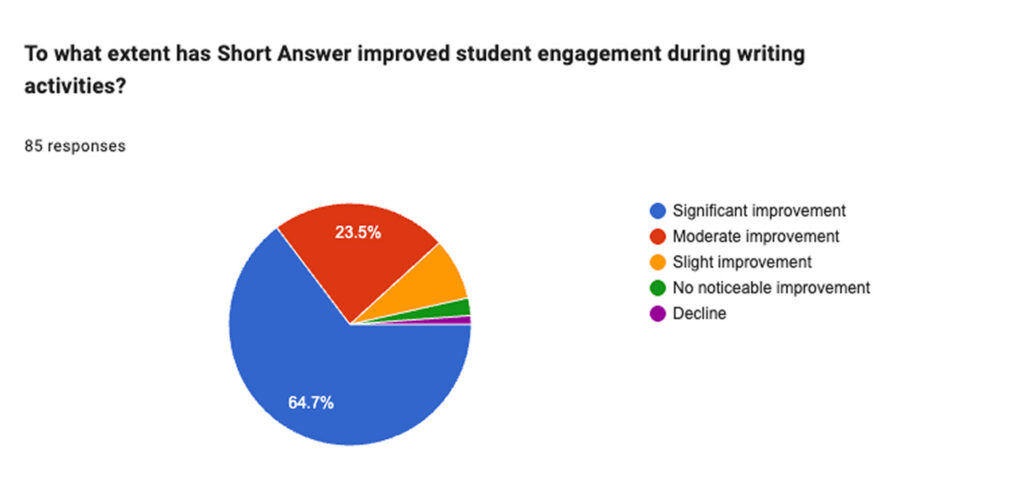
99% of survey respondents reported improvements in engagement, with almost 65% reporting “Significant Improvement.” Educators frequently described students as more motivated to write when they knew their peers would read and evaluate their work.
NPS comments reinforced this finding. Teachers repeatedly cited student excitement, participation, and enjoyment as primary reasons for recommending the platform.
One educator wrote in an NPS survey:
“My students ask when we can use Short Answer again.”
Another shared:
“Students who typically avoid writing become engaged…”
Many educators specifically highlighted Battle Royale and comparative judgment activities as powerful motivators. Rather than viewing writing as an isolated assignment completed solely for a teacher, students were writing for an authentic audience of peers.
This finding mirrors broader research, included in Short Answer’s Theory of Change, suggesting that authentic audiences and peer interaction can increase motivation and engagement. It also mirrors findings in previous case studies.
Finding 2: Teachers Believe That Short Answer Strengthens Formative Assessment and Feedback Practices
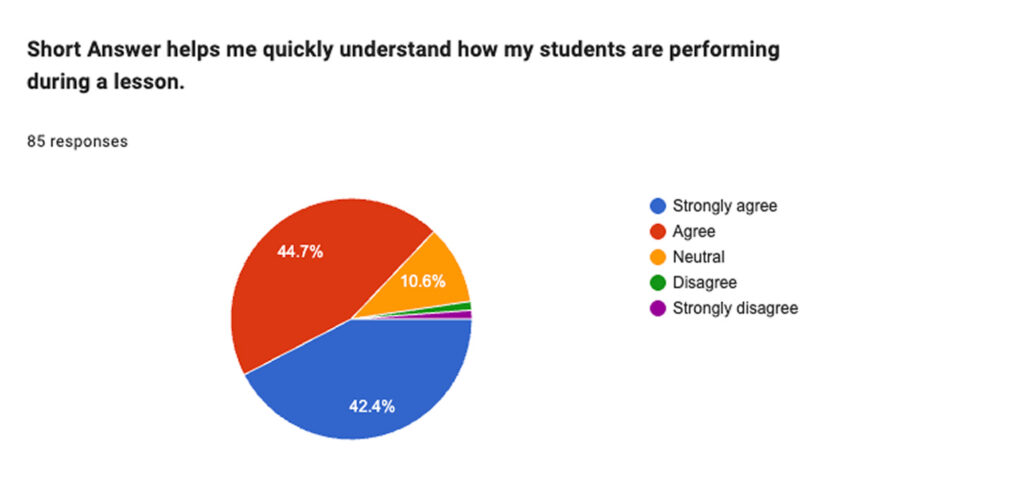
Educators consistently reported that Short Answer improved their ability to gather formative assessment data and facilitate meaningful peer feedback. 87% of teachers surveyed reported that Short Answer helped them quickly understand student performance during a lesson.
Survey responses also indicated that teachers valued seeing how students evaluated writing and the reasoning behind their choices. Many reported gaining instructional insights that would have been difficult to obtain through traditional writing assignments alone.
Teachers frequently described Short Answer as helping them:
- Identify misconceptions
- Surface writing strengths and weaknesses
- Facilitate classroom discussion around quality writing
- Gather evidence of student thinking
- Provide more targeted instruction
NPS comments echoed these themes. Educators often described the platform as a useful instructional tool rather than simply an engagement tool. One educator wrote in an NPS survey in November of 2025:
“It’s tech that serves a purpose. I really like that the students got feedback from AI pen pals and many edited their work, which they often refuse to do.”
Several teachers noted that peer review became more purposeful when students were evaluating authentic examples of student writing. Others reported that students became increasingly skilled at recognizing effective writing traits over time.
Taken together, these findings suggest that Short Answer supports formative assessment not only by collecting student writing, but also by making feedback and student judgment visible to teachers.
Finding 3: Teachers View Short Answer as a Valuable Writing Instruction Tool
Educators reported that Short Answer contributed positively to writing instruction across multiple grade levels and subject areas.
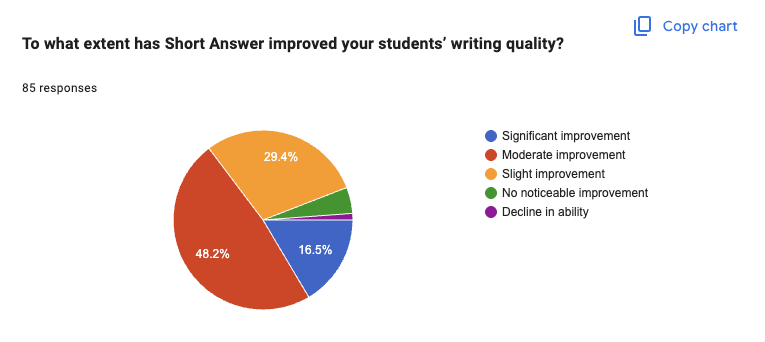
- 93% of users reported improvements in student writing quality as a result of using Short Answer
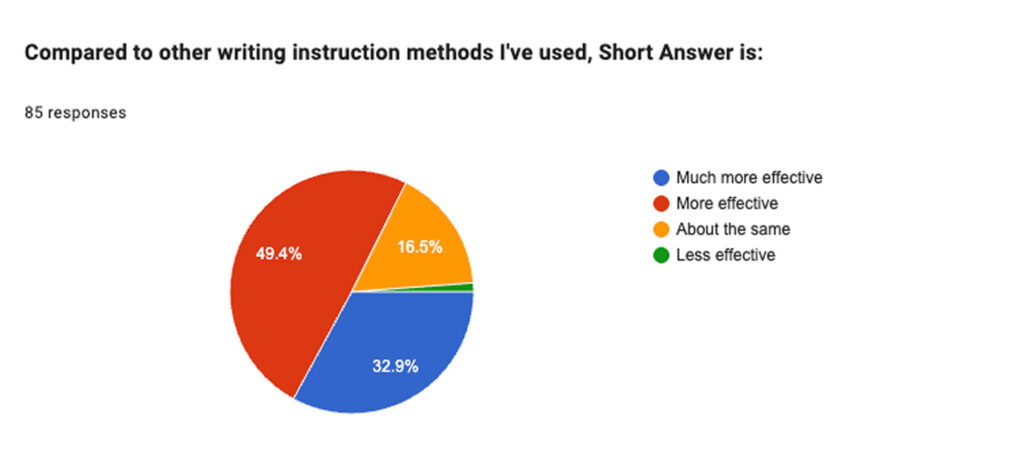
- 82% reported Short Answer as more effective than other writing instruction methods they’ve used
Teachers described several instructional benefits:
- Increased willingness to revise
- Greater attention to audience
- Improved awareness of writing quality
- Stronger peer-to-peer discussions
- More opportunities for practice and feedback
Notably, the instructional benefits above are in line with many of the best practices in K12 writing instruction identified in recent research. One educator’s comments echoed these benefits and best practices:
“The cornerstone of good writing instruction is feedback, and feedback is effective proportionally on its timeliness and personalization. Short Answer allows me to deliver that very quick feedback and monitor as my entire class progresses. That allows me to focus on crafting instruction to address class-wide gaps and provide individual intervention for those struggling.”
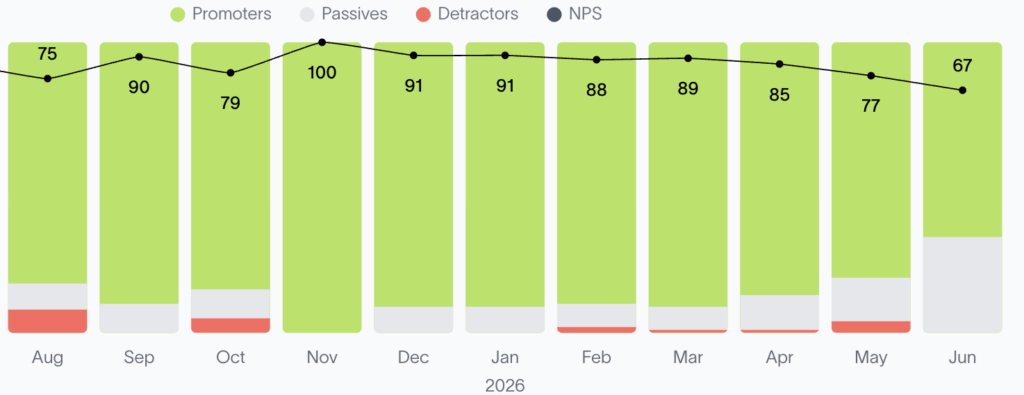
The platform’s average NPS remained exceptionally high throughout the school year, resulting in an overall NPS score of approximately 86. Importantly, positive sentiment was not limited to ease of use or engagement. 33% of comments explicitly connected their recommendation to observed improvements in writing instruction. As one NPS survey comment put it:
“Short Answer is a great way to get students to write and to reflect on their writing!”
Opportunities for Improvement
Although educator feedback was overwhelmingly positive, both datasets identified opportunities for growth. Two areas for improvement showed up across several different respondents:
1. Feedback Quality
The most consistent piece of constructive feedback from teachers described a desire for improved AI and peer feedback
“Some students have requested more specific guidance such as examples of stronger word choice that would be considered vivid.”
“I would like to see the AI feedback tool provide more specific strategies within the feedback tailored to the writing task.”
“Sometimes, it will give them the highest rating on the first round so they don’t change that item and then it rates them lower.”
“They still have a hard time evaluating their peers – to be fair, English is a second language which adds a bit of a barrier.”
“Some students took the feedback seriously and others did not.”
“When I use the program often times students pick responses that I would not have picked because they are historically inaccurate or don’t answer all parts of the prompt.”
2. Activity Length
Some teachers described a desire for more flexibility around the length of activities, as it sometimes takes too long for intended purposes:
“I wish the games/tasks weren’t so long. I teach middle school. I can’t spend an entire period on short answer…There needs to be a way to pause the game, and it saves the information so that they can work on it another day.”
“…there is only so much time in the day and while trying to run this activity it can be challenging”
“Short Answer – it’s not short.”
Some individual teachers described other areas for improvement. These included improved functionality on iPads and IOS devices, the desire for the addition of rubrics rather than only success criteria, and a better way to actually track and report on writing growth in the platform.
Limitations
Several limitations should be considered when interpreting these findings.
First, both data sources rely on educator self-report. While teachers are well-positioned to observe changes in classroom engagement and instructional practice, this study does not directly measure actual outcomes.
Second, participation in both the survey and NPS system was voluntary. Educators who chose to respond may have had stronger opinions than non-respondents.
Third, the study focuses primarily on educator perceptions rather than student experiences. Future research should incorporate student perspectives and direct measures of writing growth.
Finally, because implementation varied across classrooms, grade levels, and subject areas, individual educator experiences may differ substantially from the aggregate findings presented here.
Discussion & Conclusion
Results from this case study suggest that Short Answer continues to be a valued tool for educators. Across 85 educator survey responses and 562 NPS responses, teachers consistently reported increased student engagement, stronger formative assessment practices, and meaningful opportunities for peer feedback. Educators viewed Short Answer as a tool that helps students engage with writing as a social, collaborative process.
At the same time, the feedback also makes clear that engagement alone is not enough. While Short Answer has been highly successful at helping students participate more actively in writing activities, the next phase of product development must focus on improving writing outcomes with the same intentionality and consistency. To do so, the Short Answer team will prioritize several action items in response to educator feedback:
- Strengthen revision and feedback loops so students can more easily move from AI feedback, peer feedback, and classroom discussion into meaningful writing improvement.
- Improve activity flexibility and customization by adding more activity types, templates, rubrics, and implementation options across grade levels and subject areas.
- Address classroom workflow challenges by reducing downtime and supporting smoother pacing of in-class activities
- Measure writing growth more directly through in-app outcome measures, more targeted evidence of writing quality over time, and stronger research designs moving forward.
Through all of this, we will continue to ask and test learning-theory-driven questions like the ones seen in this case study. In doing so, we hope to continue to evolve towards an elegant and effective writing tool for K12 teachers everywhere.
Appendix
’25-’26 Educator Experience Survey responses are below. Note that some responses have been edited to maintain anonymity.
Powered By EmbedPress
NPS Survey Responses and optional comments are below. Note that some comments have been edited to maintain anonymity
Powered By EmbedPress